To get the book from Amazon, click here.
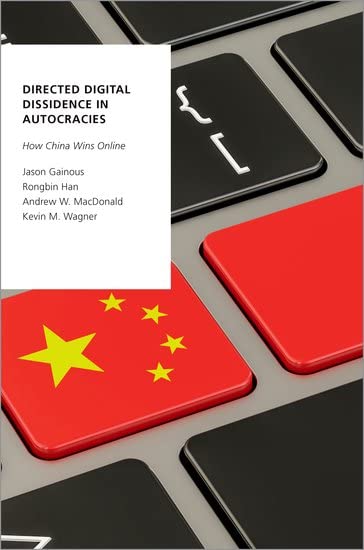 Does the Internet fundamentally change the flow of politically relevant information, even in authoritarian regimes? If so, does it alter the attitudes and behavior of citizens? While there is a fair amount of research exploring how social media has empowered social actors to challenge authoritarian regimes, there is much less addressing whether and how the state can actively shape the flow of information to its advantage. In China, for instance, citizens often resort to “rightful resistance” to lodge complaints and defend rights. By using the rhetoric of the central government, powerless citizens may exploit the slim political opportunity structure and negotiate with the state for better governance. But this tactic also reinforces the legitimacy of authoritarian states; citizens engage rightful resistance precisely because they trust the state, at least the central government, to some degree.
Drawing on original survey data and rich qualitative sources, Directed Digital Dissidence in Autocracies explores how authoritarian regimes employ the Internet in advantageous ways to direct the flow of online information. The authors argue that the central Chinese government successfully directs citizen dissent toward local government through critical information that the central government places online–a strategy that the authors call “directed digital dissidence”. In this context, citizens engage in low-level protest toward the local government, and thereby feel empowered, while the central government avoids overthrow. Consequently, the Internet functions to discipline local state agents and to project a benevolent image of the central government and the regime as a whole. With an in-depth look at the COVID-19 and Xinjiang Cotton cases, the authors demonstrate how the Chinese state employs directed digital dissidence and discuss the impact and limitations of China’s information strategy.
Reviews:
“This book is an essential resource for anyone interested in how autocracies channel online information flows towards regime survival. It provides insightful analysis that will help both students and practitioners better understand how authorities in China use the Internet to give citizens a voice but also to steer citizens’ resistance and protest away from the central government. This lively book is a must read for the times we live in.” — Genia Kostka, Professor of Chinese Politics, Freie Universität Berlin
“This impressive new book examines how China’s rulers shape online discourse to redirect dissident impulses away from themselves and toward local governments. Using new survey evidence and case studies, the authors find that autocrats can survive and even benefit from the new information flows unleashed by the internet.” — Peter Lorentzen, Associate Professor of Economics, University of San Francisco
“This innovative and well researched book sheds new light on how the Chinese authoritarian regime has been able to sustain itself by controlling online communication. The theory and empirical demonstration of ‘directed digital dissidence’ presented in the book are a key contribution for all researchers interested in the relationship between the internet, freedom, and control.” — Cristian Vaccari, Professor of Political Communication, Loughborough University
 Rongbin Han