Contesting Cyberspace in China: Online Expression and Authoritarian Resilience (Columbia University Press, 2018). To get the book from Amazon, click here.
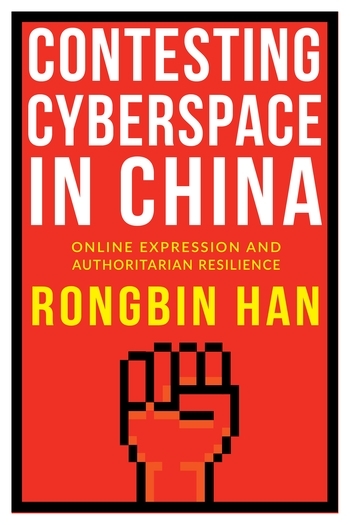
For many, the Internet was supposed to be an antidote to authoritarianism. It can enable citizens to express themselves freely and organize outside state control. Yet while online activity has helped challenge authoritarian rule in some cases, other regimes have endured: no movement comparable to the Arab Spring has arisen in China. Drawing on a rich set of data collected through interviews, participant observation, and long-term online ethnography, as well as official reports and state directives, Contesting Cyberspace in China interrogates our assumptions about authoritarian resilience and the democratizing power of the Internet. The book offers a counter-intuitive explanation for the survival of the world’s largest authoritarian regime in the digital age by revealing the complex internal dynamics of online expression in China, especially how the state, service providers, and netizens negotiate the limits of discourse. The book argues that state censorship has conditioned online expression yet has failed to bring it under control. However, the Internet has proved less threatening than expected due to the multiplicity of beliefs, identities, and values online. Freer expression while empowering regime critics, may work to the advantage of the regime because state-sponsored and spontaneous pro-government commenters have turned out to be a major presence on the Chinese internet, denigrating dissenters and neutralizing criticisms targeting the regime.
Reviews:
“If you are looking for that long-awaited book on China’s Internet censorship, look no further. Rongbin Han’s Contesting Cyberspace in China illuminates the labyrinths of that proverbial cat-and-mouse game with clarity and sophistication. It will be a thought-provoking and rewarding read.”—Guobin Yang, University of Pennsylvania, author of The Power of Internet in China: Citizen Activism Online
“How has the Internet changed state-society relations in China? How have social groups engaged in a “guerrilla war” with the authorities over cyberspace? And how is the Internet remaking China? In this empirically rich work, Rongbin Han has provided us with a vivid analysis of the interactions between the state and society in China’s cyberspace. Those who are interested in cyber affairs must read this brilliant book.”—Zheng Yongnian, National University of Singapore, author of Technological Empowerment: The Internet, State, and Society in China
“Contesting Cyberspace in China goes beyond the typical fascination with Chinese censorship and internet controls. It investigates the ways in which social media and online expression are pluralizing political debate in China, giving ample room for fiery nationalists and indignant leftists to attack the regime’s liberal critics. The book is an excellent study of the diversity, drama, and defiance of China’s netizens.” —Mary E. Gallagher, University of Michigan, author of Contagious Capitalism: Globalization and the Politics of Labor in China
The book is reviewed in:
South China Morning Post by Kyle Hutzler (here), American Journal of Sociology by Dr. David Kurt Herold (here), International Journal of Communication by Dr. Markus Breen (here), Perspectives on Politics by Dr. Peter Gries (here), The Journal of Asian Studies by Dr. John James Kennedy (here), The China Journal by Dr. Jian Xu (here), China Perspectives by Dr. Séverine Arsène (here), Chinese Journal of Communication by Dr. Shaohua Guo (here), Journalism & Mass Communication Quarterly by Dr. Gabriele de Seta (here), Pacific Affairs by Dr. Hualing Fu (here), Journal of Chinese Political Science by Dr. Maria Repnikova (here), Journal of Cyberspace Studies by Dr. Gordon Alley-Young (here), Contemporary Sociology by Dr. Alexander Dukalskis (here), East Asian Journal of Popular Culture by Dr. Marc Moskowitz (here), Mobilization by Dr. Jean Yen-chun Lin, and CHOICE: Current Reviews for Academic Libraries by J.A. Steven.
 Rongbin Han